Lava rock and forged steel.
Tom Weiskopf's last course, built on a lava field in Utah, and Japan's forged irons as the Tour plays Yokohama. Plus AI-sharpened aerials on 14,139 course maps.
I've never hit a Miura. After reading how they're made, heated, struck, reheated and struck again, I want to. This week is Japan's craft, the course the Tour just left, and the quiet work of telling a kept course from an abandoned one from the sky.
Black Desert's hardest and easiest holes sit three apart
Austin Smotherman won the Bank of Utah Championship on Sunday at 26 under, two shots clear of Doug Ghim. It was his first PGA Tour win, in his 100th start, and his 258 is a new record for the three-year-old event.
He nearly gave it away on the back nine. Smotherman made double bogey at the 13th, the second- hardest hole of the week, then birdied the 14th right after. That was the right hole to need a birdie on.
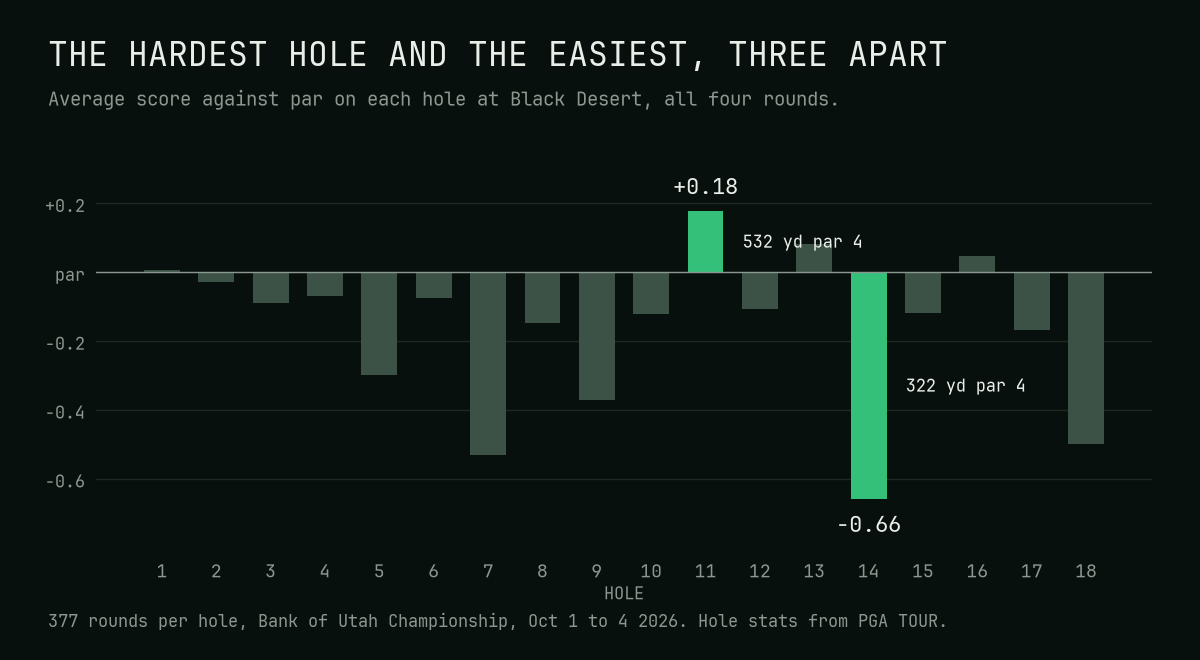
Over 377 rounds the 11th, a par 4 of more than 530 yards, played 0.18 over par and gave up just 42 birdies. Three holes later the 14th played 0.66 under. It gave up 250 birdies and 10 eagles, more birdies than any hole on the course, the par 5s included.
The takeaway: a double hurts less with a hole like the 14th coming. The course item below explains why these two holes play the way they do.
Hole stats: PGA TOUR's course stats for the week. Result: PGA TOUR and Golf Channel, Oct 4.
OPEN BLACK DESERT →Tom Weiskopf's last course is cut through a lava field
Tom Weiskopf won 16 times on Tour, the 1973 Open among them, then spent his second career designing courses. His last one runs through an ancient lava field in Ivins, Utah, on black basalt that once flowed from volcanoes. He died in August 2022, nine months before Black Desert opened. Before he did, he narrated a hole-by-hole flyover of it.
Weiskopf and his design partner Phil Smith made most of the fairways 70 to 100 yards wide. The rock is what's off them.
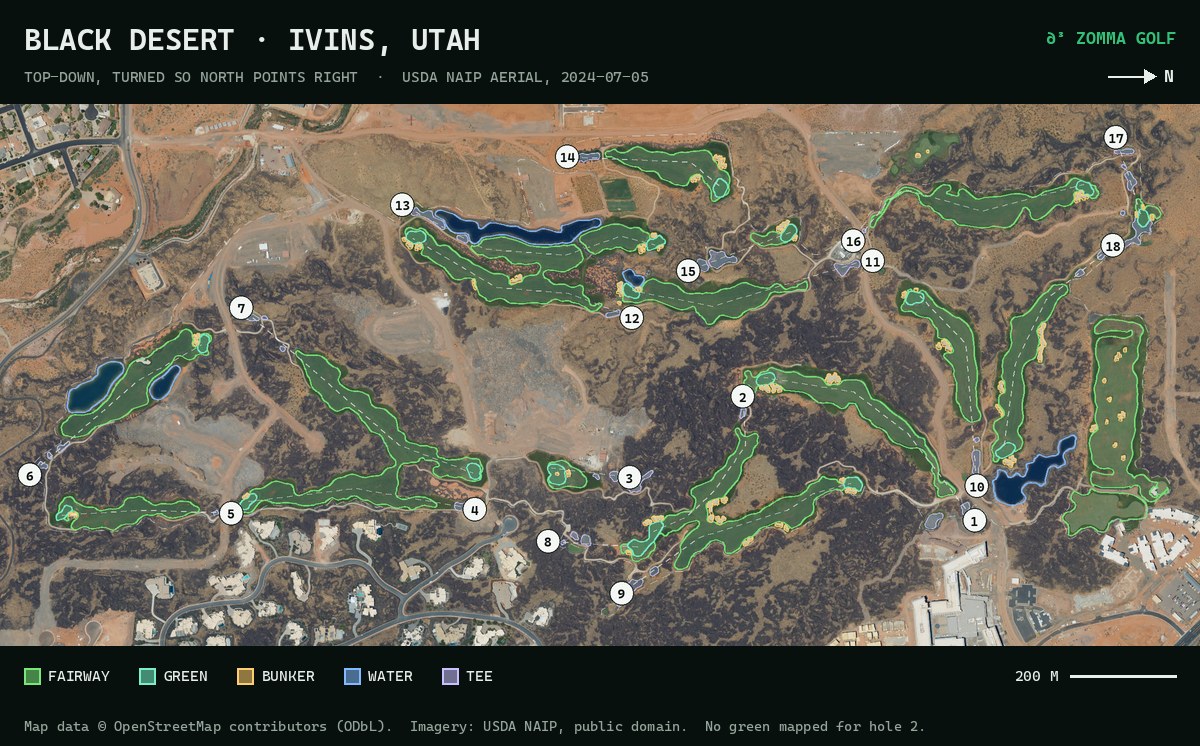
Then they bent the card both ways. From the Tournament tees, the 11th is a 536-yard par 4; fewer than one US course in 300 that we hold a full card for lists a par 4 that long. Three holes later, the 14th is 316 yards, one of two par 4s you can drive, along with the 5th. Drivable par 4s were a Weiskopf signature.
The air helps a little. At 2,970 feet the ball carries about 3.5% farther than at sea level, so the 11th plays more like 518. Still long.
The takeaway: on a course with fairways this wide, the hole to plan is the short one. Decide on the tee whether you're going for the 14th green, and where you want to miss if you do.
Hole yardages: the Tournament tee on the card we hold, par 72. The Tour plays it at par 71. History: Black Desert's opening release, May 2023.
SEE BLACK DESERT'S CARD AND MAP →Japan's irons are still made by hand
The Tour tees off in Yokohama tonight, in the city where Honma opened a small workshop in 1959. It's a good week to ask why golfers go quiet when they talk about a Japanese forged iron.
Start in Himeji, a castle town west of Kobe. By Miura's account, the first iron made in Japan was forged there in 1928. Katsuhiro Miura founded his company there in 1977. Miura still heats soft carbon steel to 1,200°C, strikes it, then reheats it and strikes again. Miura compares the work to sword making: 'human sensitivity' in the steps that decide a head's balance, 'instead of relying solely on statistics and numbers generated by computers.' He died in 2025, aged 82.
The others tell it the same way. Honma builds in Sakata, where it says 360 craftsmen work and every club passes through 100 people's hands over six months. Mizuno forges its Grain Flow heads only at its Hiroshima plant, from a mild carbon steel it picks 'for a soft, responsive touch.'
Feel doesn't fit in a spec table. Consistency does, and Miura publishes a head weight for every iron.
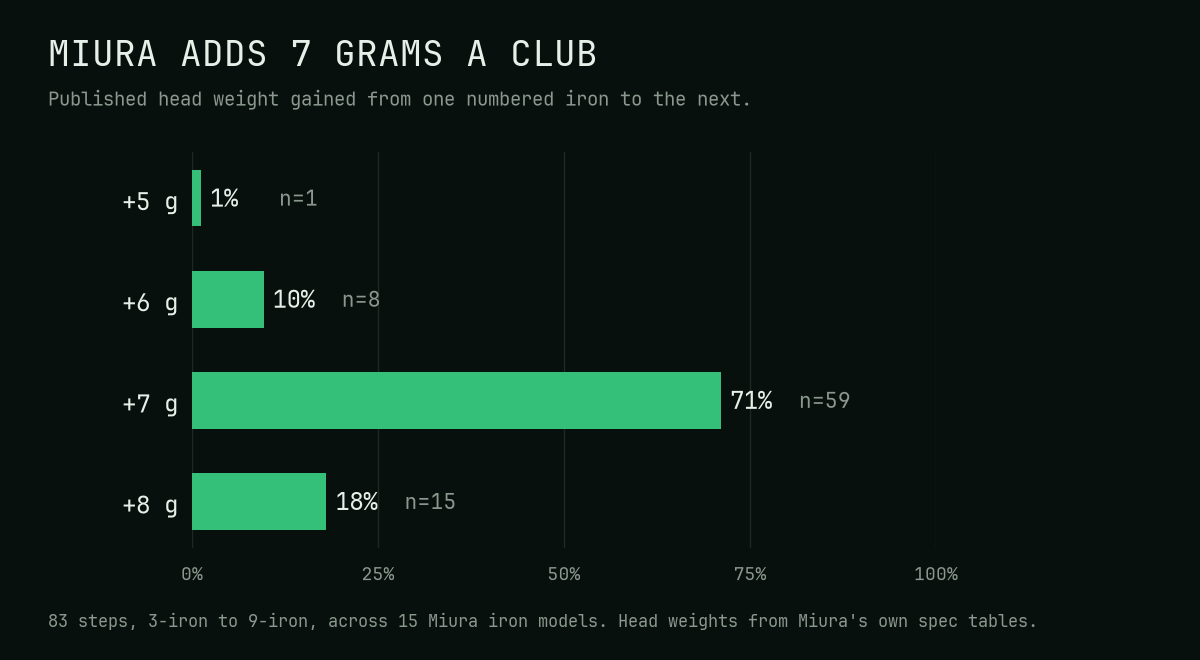
The takeaway: if you test a forged Japanese set, hit three irons in a row, not one. The even steps are the point.
SEE THE MIURA MB-101 SPECS →We graded 6,296 courses on how well kept they look
Our green-finding AI learns from courses where volunteers traced the greens on a map. The catch: some of those tracings sit on greens that aren't greens anymore. A course closes, the fairways go to hay, the woods grow back, and the map never hears about it. Teach the model on those and it learns that a hay field can be a green.
So we ran a census. For every course with an aerial photo and mapped greens or bunkers, a script looks for three things a kept course shows from above: greens smoother than the ground around them, clean sand in the bunkers, and a crisp edge where green meets fringe. Each course is ranked only against courses from the same state's photo survey, because some states' photos simply come out hazier than others.
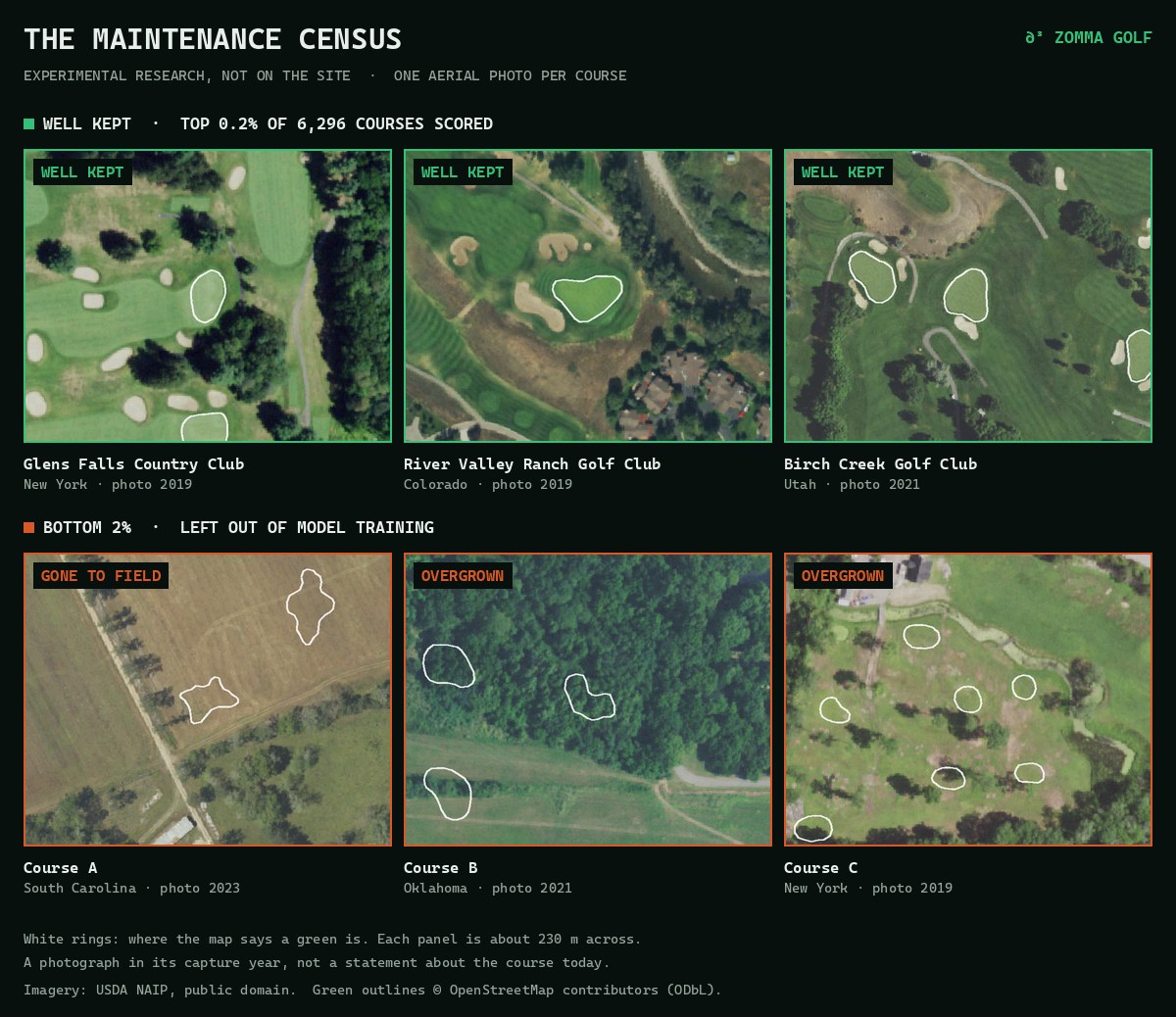
6,296 courses got a score. The bottom 5%, 314 courses, now sit out of training. At the very bottom, the photo usually tells the story on its own.
One honest caveat: it grades photos, not courses. Some of these pictures are years old, and a course that looked rough in 2019 may be lovely now. Nothing from the census reaches a course page.
SEE AN AI-ENHANCED COURSE MAP →- Sharper course maps, on 14,139 courses. Our course maps now carry an AI-enhanced aerial, with a switch on the map's frame back to the photo as shot. →
- The ocean is water now. Pebble Beach's 7th, 8th and 18th used to plan as if the Pacific were out of bounds. Plans now treat the sea as water. →
- Plus handicaps. A plus index now plans between scratch and a Tour player, instead of stopping at scratch. →
- A real Stop button in the studio. Stop a turn mid-answer, or close the tab and come back to it still running. →
Could you tell a forged iron from a cast one with your eyes closed?
Reply and tell us, and what you play now.
See you next week,
Blake