Same name, different shaft.
One in five premium stock shafts isn't the one sold on its own. Plus the Tour's return to Asheville, mapped, and a computer learning to find greens.
Welcome back. The PGA Tour is in the North Carolina mountains this week, so we mapped the course they're playing. We also trained our own AI to spot greens from the sky, and this time I brought pictures. First, though, a question about the shaft in your driver.
Same name, different shaft
Next time a driver tag says it comes with a Denali or a Kai'li, read the fine print. Sometimes that's the exact shaft you could buy on its own. Sometimes it's a "made for" version, built to the club company's recipe and wearing the same name.
We went through every stock shaft option on the manufacturer pages we track. All 864 of them. 194 were made-for builds, a little over one in five. The bigger story is who's doing it.
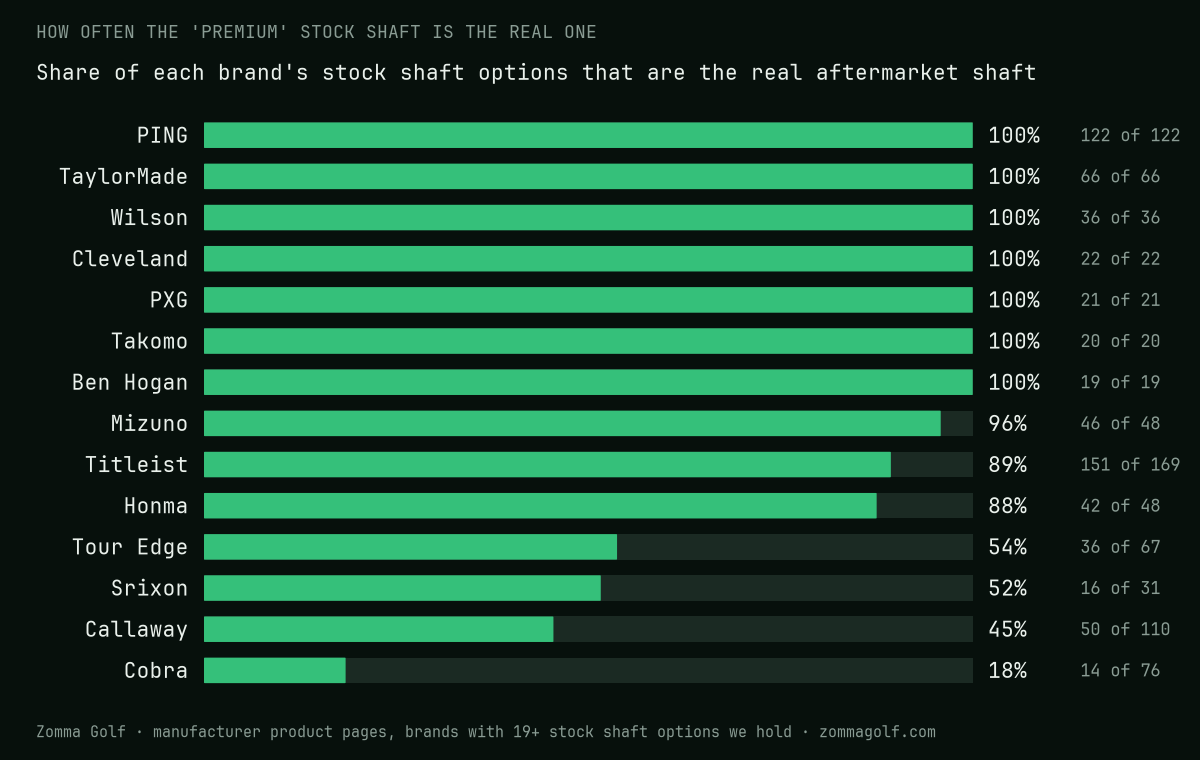
Is made-for worse? Not necessarily. Sometimes it's the same shaft, a touch lighter or softer. But sometimes it bends differently, and the name won't tell you. Take Cobra's stiff Kai'li Blue 60: 66 grams, same as the stiff Kai'li Blue Mitsubishi sells. Cobra lists the kick point as mid. Mitsubishi lists its own as high. Same name, same weight, different shaft.
The takeaway: if the shaft is why you want the club, look for "made for" on the spec sheet, or ask your fitter what the real one costs.
These are the listings we've captured so far. Brands we're still collecting could move.
SEE THE SHAFTS SIDE BY SIDE →The Tour's first trip to Asheville since Hogan
The last time the PGA Tour stopped in Asheville, Ben Hogan won. Then he won the next year. Then the year after that, 1940 to 1942. It took more than 80 years, but the Tour is back: the Biltmore Championship starts today at The Cliffs at Walnut Cove, a Jack Nicklaus design sitting 2,274 feet up in the Blue Ridge.
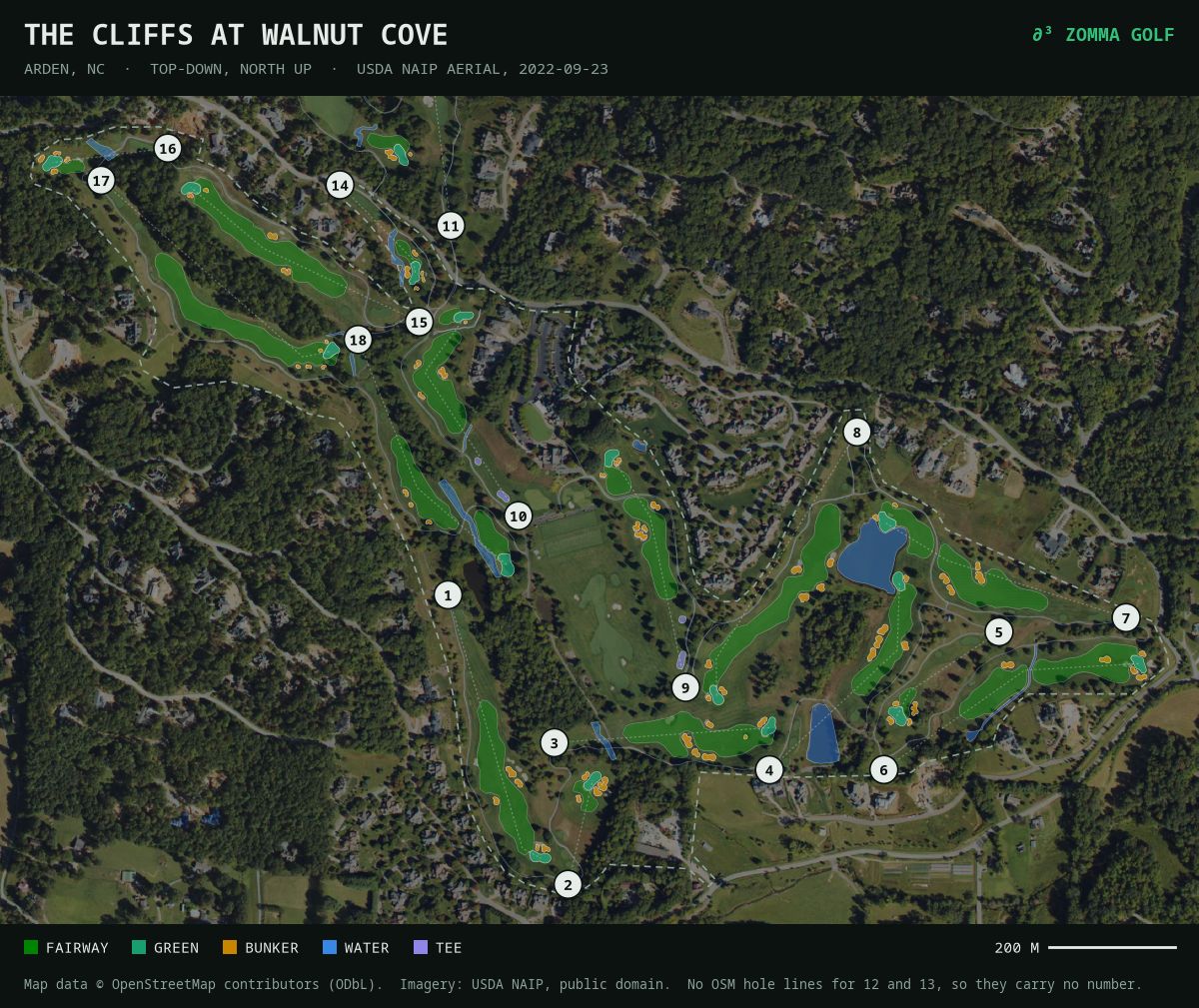
On paper it's 7,167 yards and par 71, which is short by Tour standards. The rating disagrees: 75.2, with a 148 slope from the back tees.
A lot of that lives in the par 3s. There are five, which fewer than one in five 18-hole courses can say, and the three on the back nine play 244, 205 and 196. The mountain air helps a little. At that elevation a full shot carries about 2.6% farther, so a 200-yard club flies closer to 205. The pros will take it.
EXPLORE WALNUT COVE →We trained our own vision AI to spot greens from the sky
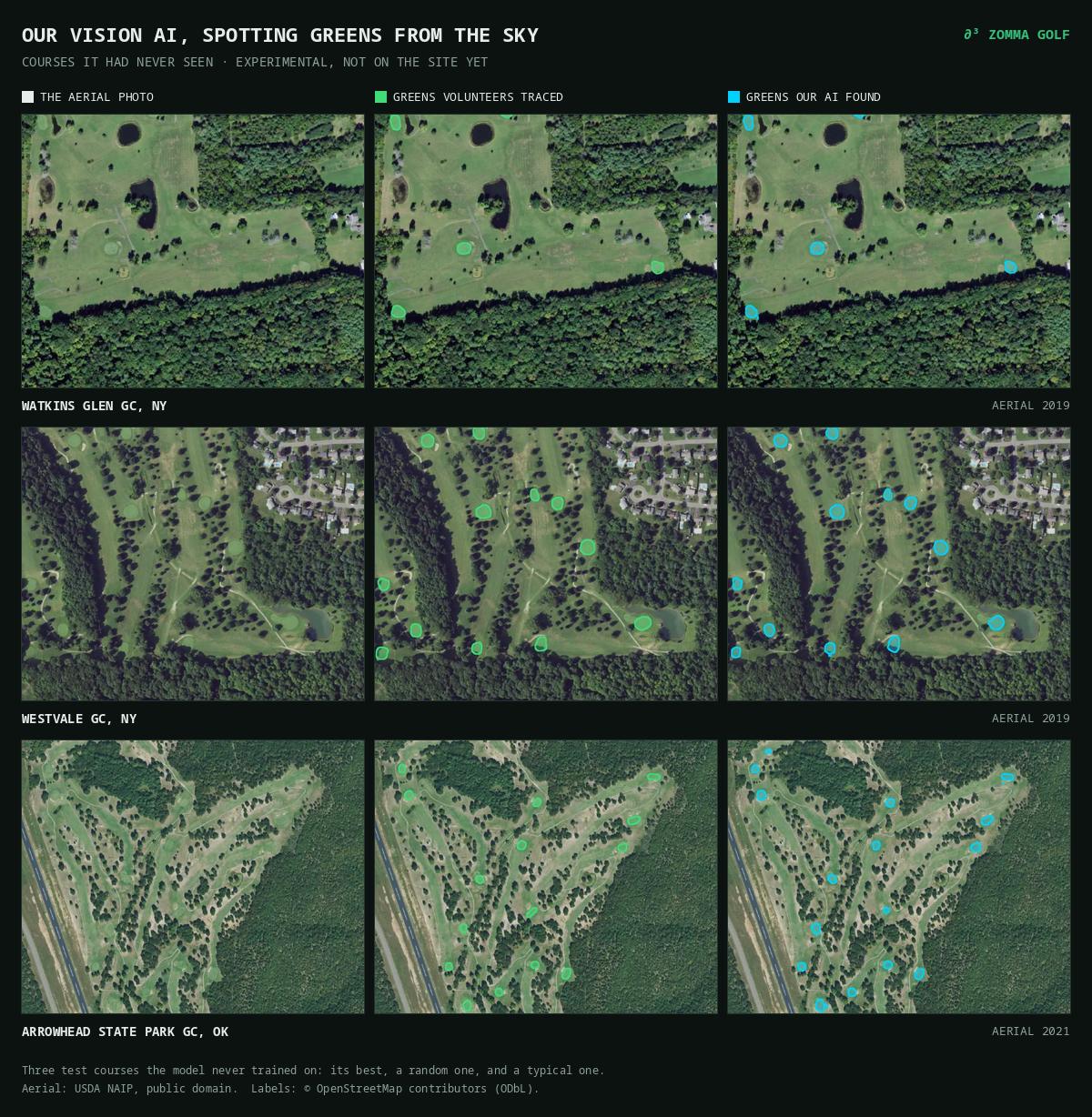
Here's a problem you'd never notice: 8,403 courses on Zomma have an aerial photo and not one green outlined on it. Every course map on the site was traced by a volunteer, one shape at a time, and there aren't enough volunteers to finish the job. So we built our own mapper.
It's a vision transformer that already knew aerial photos before we got to it. We taught it golf, using about 2,000 courses volunteers had already mapped and the same USDA aerials you see on our course pages. The next version is learning fairways, bunkers, water and tees too.
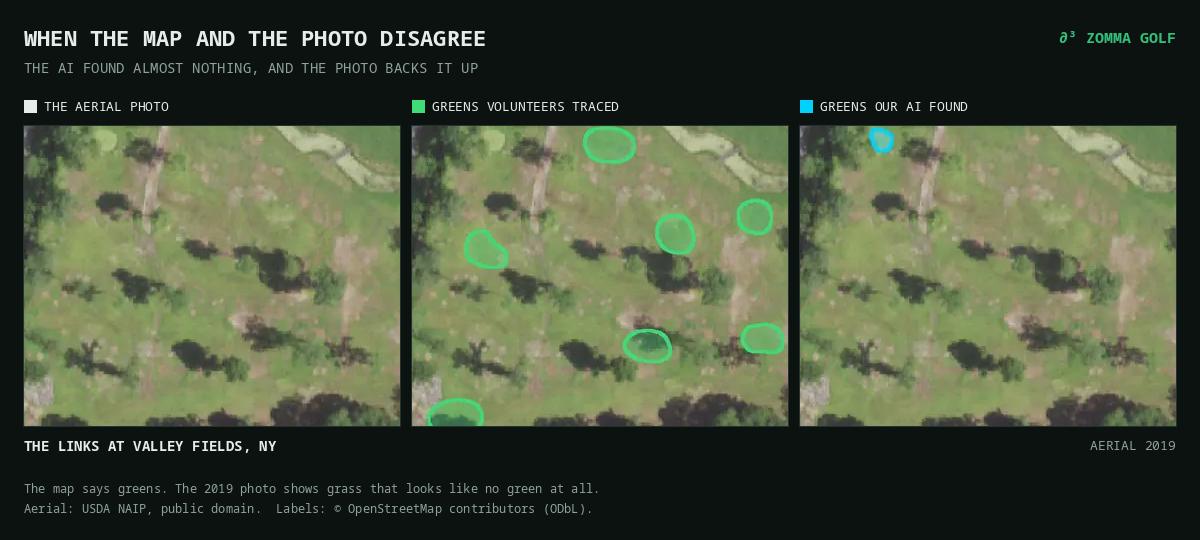
Our favorite result is when the AI disagrees with the map. At one New York course the volunteer map still shows greens. The AI found almost nothing, and the photo backs it up.
Report card so far: good at greens, bad at tee boxes, which from a plane are barely a smudge. Nothing it draws goes on the site until it passes a check we grade by hand, hole by hole.
SEE A COURSE FROM THE SKY →- Ask your AI assistant about golf courses. Connect Claude or ChatGPT to Zomma Golf and it can find a course, read the scorecard, plan a hole or a round, and pull up your own numbers. It's an early beta. →
- 29 Hawaii courses now have aerial maps. →
- Search from any page. Type a course or club into the box at the top and go straight there. →
Coming next: shot-by-shot planning from anywhere on the hole.
See you next week,
Blake